Supercharge Influencer Campaigns to Optimize Marketing Impact
The solution aims to streamline the discovery, outreach, and analytics of influencer-led campaigns for various stakeholders
INTRODUCTION
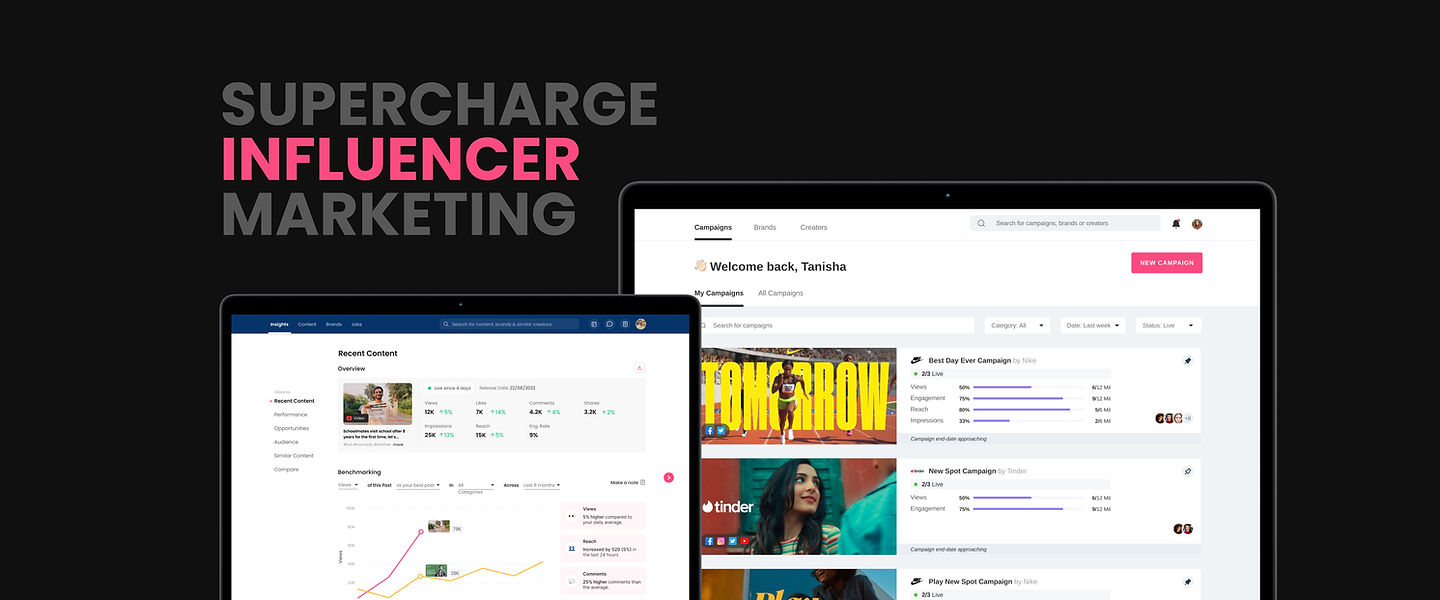
This was an influencer marketing solution that helped to discover, target, optimize, and measure content opportunities for creators, talent managers, brands, and agencies. Its main objective was to consolidate the process by streamlining discovery, outreach, and analytics within a single platform.
MY ROLE
I worked as a product designer, handling UX requirements and creating UI screens
TIMELINE
36 weeks
PROJECT SCOPE
Team of 2 product designers, 2 product managers, and the development team
TOOLS
Figma, Figjam
GOALS
The solution focused on modules that would come together as a unified product to achieve the following goals:

DISCOVERY
After conducting user interviews involving multiple stakeholders and benchmarking products across various categories, the study revealed the following findings.
CAMPAIGN MODULE
The user persona for this module was a campaign manager at an agency seeking to set up, manage logistics, and analyze the performance of a campaign once it is launched. Some of the key insights from the interviews were:
-
Campaign Managers undertake a lot of manual data entry to track campaign and brand performance
-
The information about brands and campaigns is very scattered and hard to locate easily
-
It is cumbersome to track content pieces belonging to a specific campaign
-
The performance of campaigns is tracked across multiple Excel sheets
-
It is tedious to keep updating performance metrics based on content performance
CREATOR MODULE
The user persona for this module was a creator interested in tracking their performance across various platforms and benchmarking it against the industry. Some of the key insights from the interviews were:
-
Creators rely on platform-specific analytics to analyse how their platforms are performing
-
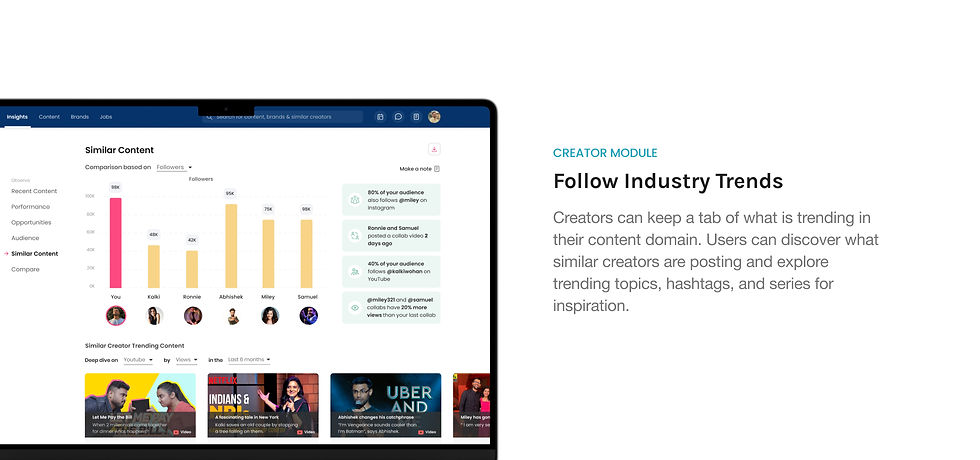
Creators cannot ascertain the true performance of content as it cannot be compared or benchmarked to other content pieces or industry benchmarks
-
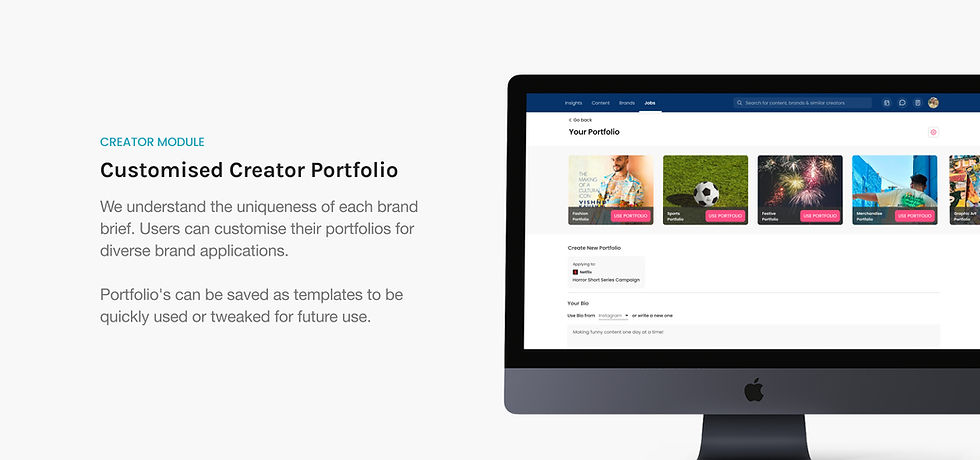
Creators typically use a standard PPT pitch document when applying to briefs, which needs manual tweaking each time to align with the brand's specific requirements.
-
Social media posts have to be manually scheduled on calendars, requiring creators to strategize content separately for each platform.
DISCOVERY MODULE
The user persona for this module was a talent manager aiming to discover the right talent for a brief and guide creators in crafting relevant content for the brand. Some of the key insights from the interviews were:
-
Discovery of talent currently takes place via third-party products
-
These products do not deliver the best search results due to filtering or data limitations
-
Discovering campaign briefs and brands is a rare scenario
-
Creators have to directly approach brands to understand if there is an ongoing campaign they can work on
-
Discovering creators that match the brand’s requirements is a tedious process

DESIGN PRINCIPLES
The building blocks that helped to shape the final solution


SOLUTION
The final solution we designed addressed the problems of each type of user, highlighting some of the key interventions we crafted in each module.




CONCLUSION
Following the design process, we successfully addressed the problem statements for various user types. The high-fidelity wireframes are currently undergoing user testing, and the inputs gathered will be documented for refinement and iteration purposes.
The next steps involve handing over the designs to the development teams and initiating the next design sprint. This sprint will focus on implementing advanced features, such as detailed creator profiles with audience insights, smart discovery of creators, note-taking, and creator communication channels, among others.
Thank you for taking the time to read my case study! ⚡️